This is a collection of general recommendations to other inspiring macro photographers, or people interested in jumping spiders or other arthropods.
Firstly, I recommend reading Nicky Bay’s Macro Photography Ethics, a well thought out lesson on how to practice macro-photography in harmony with your subjects. I do my best to follow Nicky Bay’s interpretation of macro photography ethics, but here are four general rules of mine for any animal photography that I would recommend following, especially as a macro photographer:
- Treat your subjects with respect. Do you really love what you’re doing if you mistreat the animals you’re doing it with?
- Know your subjects’ limits. If what you’re doing is completely stressing them out, know when to stop.
- Never force your hand. If you can’t get the photo you want by reasonable means, try something else! Be patient and don’t force your subject to do what you want.
- Depict your subjects accurately. Is your scene even possible in nature? Do you represent your subject’s habitat and lifestyle well?
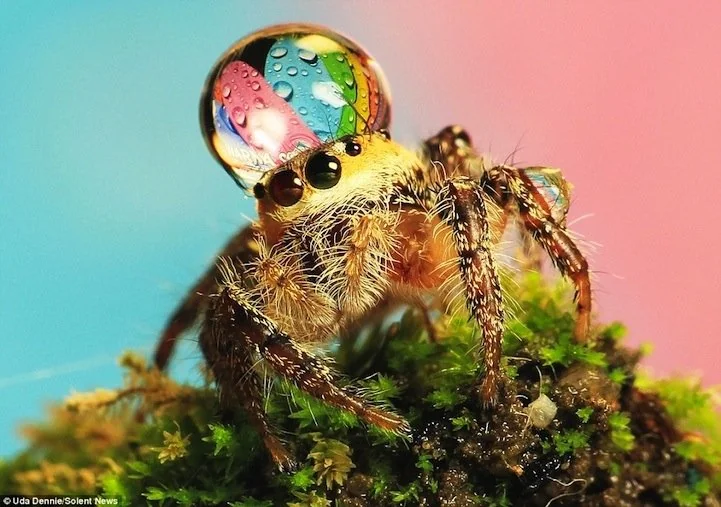
Here is an example of what I would consider poor macro photography ethics. Many water droplets were placed on this jumping spider before the final photo was taken, as evidenced by the soaking prop below, and the spider itself looks manipulated and stressed (otherwise it likely wouldn't tolerate the water droplet on top). Jumping spiders very seldom get water droplets on them in the wild. The background colors and moss prop are also unrealistic and do not give the spider's actual habitat any credit. © Uda Dennie/Solent News
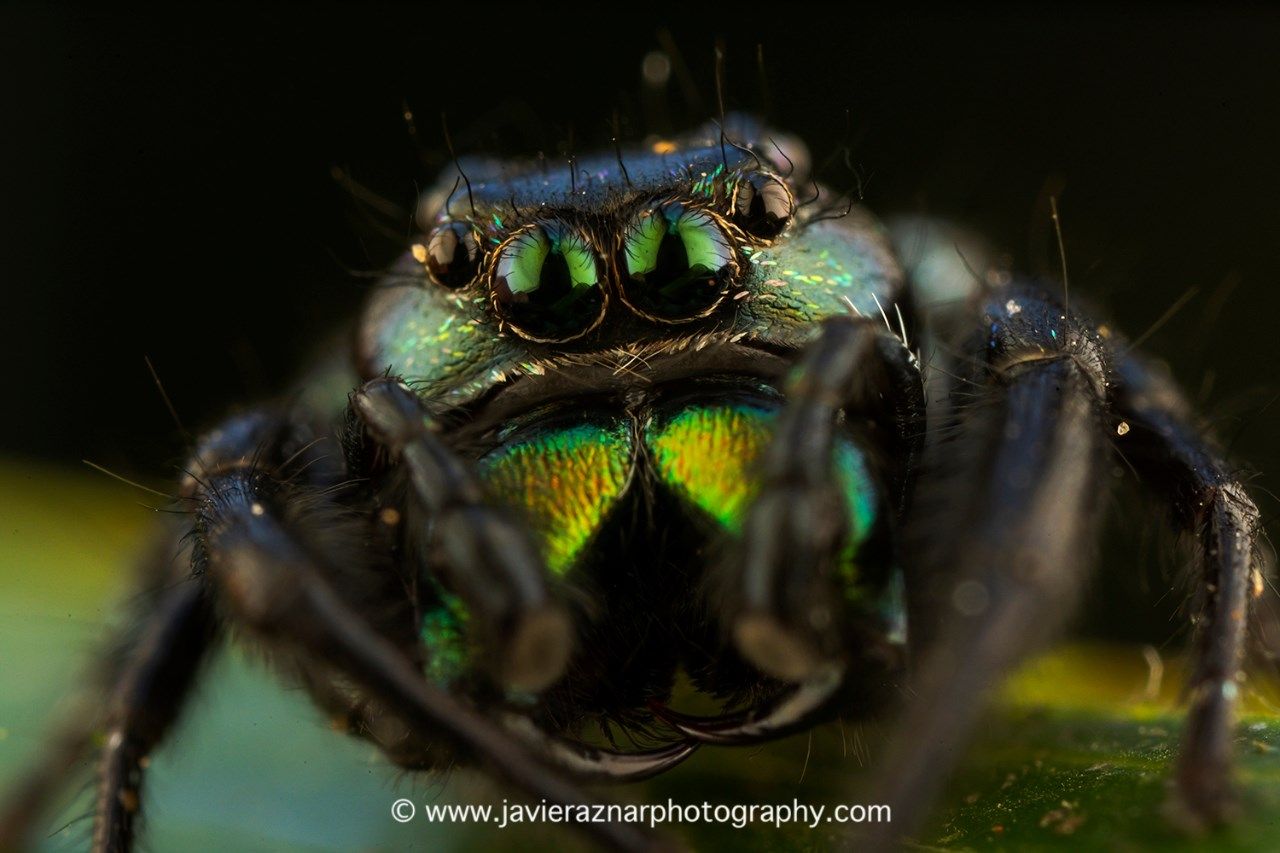
An example of good macro photography ethics. This Paraphidippus was not photographed exactly where it was found, but moved onto a leaf with minimal manipulation after being found (per the author), photographed, and released in the original place it was found after a few photos. The spider is relaxed and in a natural pose, does not appear stressed at all, and because they are often found on leaves, this photo represents the spider very well! © Javier Aznar Gonzalez de Rueda (https://www.facebook.com/javieraznarphotography)
Perhaps the most publicized photo explicitly showing poor macro photography ethics was the 2011 winner for the National Geographic Photo Contest. The respected magazine aided credence to this photo despite it being a fake and probably a case of animal abuse, and didn’t back down or condemn the staged photo even when the author admitted it. Since then, this photographer has resorted to other forms of photography abuse, such as using strings to manipulate his specimens. In many of his recent photos of jumping spiders, it is obvious that either the jumping spider is already killed and is being manipulated to look more alive, or the specimen’s palps are being held up artificially (likely by a string) and the specimen held in place securely for a long focus stack.
Although this kind of photography may appear beautiful and may even attract people to learn more about the world of arthropods, it's increasingly important that people are aware of this type of abuse so that photographers are held to high standards and their subjects are not put through needless stress/abuse. For a complete discussion on this topic, and many good ethics recommendations to aspiring macro photographers which I agree wholeheartedly with, please read the excellent article “Why Bug Photography Ethics Bug Me” by Danae Wolfe, and as sad as it is, the things mentioned there actually happen on a daily basis.
To sum it up - Always represent your subject accurately and respect it’s boundaries. Happy shooting out there!